


It’s amazing how quickly the AI chatbot has evolved from a cool futuristic gadget into a regular part of our daily lives. Whether you’re navigating a banking issue, searching for a new recipe or debugging a complex code, there’s almost always a chat interface on standby to assist you.
Nevertheless, for every user who finds value in the efficiency of an AI assistant, there’s a vocal segment of the population that actively avoids them. They’d prefer to wait on hold for an hour to talk to a human than spend just five minutes with a machine. What fuels this resistance? Is it simply a generational issue, or is there a deeper psychological barrier to how we engage with technology?
In this article, we’ll investigate the various reasons that lead people to avoid AI chatbots. We’ll also discuss the limitations of today’s synthetic conversations and what businesses should consider to help close that gap.
The Rise of the AI Chatbot
With the integration of LLMs (Large Language Models) and generative AI, chatbots have become more intelligent, quicker and sound more human than ever before. Companies are deploying them to save money, provide support around the clock and handle a high volume of inquiries with perfect consistency. However, just because it’s efficient from a business standpoint doesn’t always mean users are left feeling satisfied.
Why Users Resist AI Chatbot Interactions
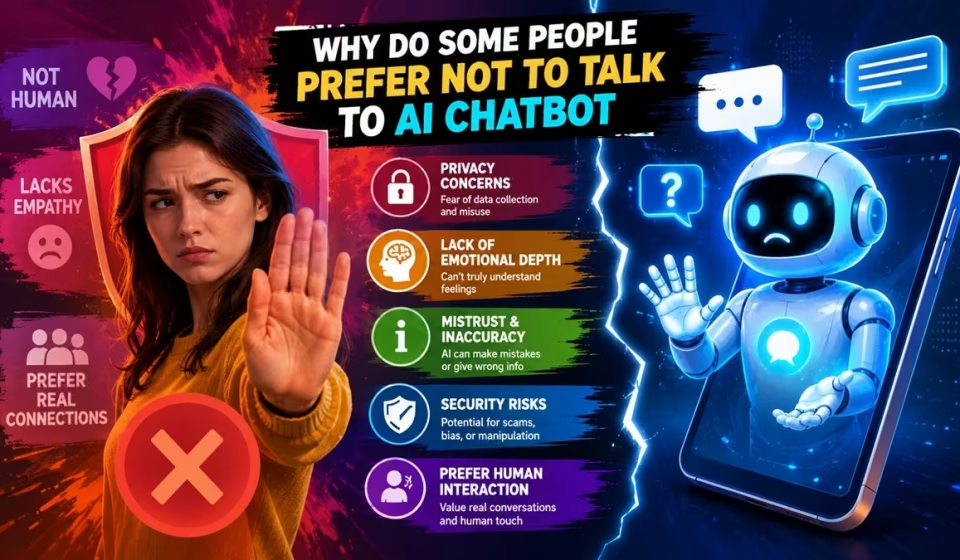
To give you a quick overview, here’s a table that points out the primary reasons why so many people prefer to avoid engaging with AI chatbots.
| Reason | Description | Impact on User Experience |
|---|---|---|
| Lack of Emotional Connection | AI cannot genuinely empathize or understand feelings | Users feel unheard and disconnected |
| Privacy Concerns | Fear of data misuse, security breaches or unauthorized tracking | Users hesitate to share personal information |
| Trust Issues | Doubts about accuracy, reliability and company motives | Users question the usefulness of responses |
| Frustration with Limitations | Struggles with complex queries and context | Wasted time and increased frustration |
| Need for Human Judgment | Situations requiring experience, creativity and nuanced thinking | AI seen as too limited for important decisions |
| Fear and Anxiety | General unease about AI technology and its implications | Avoidance due to discomfort |
| Contextual Misalignment | Sensitive or highly complex situations requiring human discretion | AI perceived as inappropriate for certain conversations |
The Human Connection
Human interaction has this unique quality that you just can’t replicate. When you talk to someone, there’s this whole spectrum of emotional nuance, empathy and understanding that unfolds. You can feel the difference between someone who genuinely cares about your struggles and someone who’s just going through the motions.
Even with all their advancements, AI chatbots still have some gaps in this area.
A lot of people feel that chatbots just don’t have the capacity to truly understand their concerns. When you’re feeling overwhelmed, frustrated, or dealing with a complicated situation, it’s essential to talk to someone who really gets it. You want to hear them say “I understand how frustrating that must be” and know they genuinely feel for you. An AI can mimic those phrases, but it just doesn’t have that authentic connection.
Have you thought about the last time a chatbot made you feel genuinely heard? I’m willing to bet it hasn’t happened at all.
For a lot of users, the absence of emotional connection is a big turnoff. We’re social creatures and crave for that authentic human interaction. No matter how advanced AI chatbots get, they just can’t provide the same warmth as a genuine conversation with another human being.
Privacy and Data Concerns
As data breaches continue to grab headlines week after week, it’s no surprise that privacy concerns are reaching new heights. When it comes to AI chatbots, they’re really just tools for gathering data.
When you chat with an AI chatbot, you often find yourself sharing personal information, asking about different products or services and maybe even disclosing details about your life, problems or preferences. This can be quite uncomfortable for many people.
Where does this data end up? Who has the rights to access it? How secure is it?
These are valid questions that often leave us wanting more clarity. Many users are understandably cautious about how companies handle the information collected during chatbot conversations. Are they selling this information? Using it to serve targeted ads? May be storing it in ways that might be exposed to hackers?
With all the uncertainty surrounding data privacy, it’s no wonder that many people hesitate to use AI chatbots. They often prefer to connect with a human representative through a phone call or email where they feel more secure sharing their sensitive information with someone they trust.
This sense of caution is particularly strong among older folks who grew up when privacy was taken more seriously. They might not have a full understanding of how AI technology works, which can make them feel uneasy. The black box aspect of AI can be quite intimidating, as it feels like you’re dealing with something that operates in ways that are beyond our understanding.
Trust Issues
Trust really is the cornerstone of all communication, whether we’re talking about interactions between people or between people and machines. When it comes to AI chatbots, building that trust can be quite a challenge.
To begin with, accuracy is a big concern. AI chatbots sometimes provide wrong information, make assumptions or completely misunderstand what you’re asking. They’re definitely getting better, but still not flawless. When you’re relying on accurate information, especially for medical, legal or financial matters which you really can’t risk depending on a system that might be incorrect.
Let’s be real for a moment. How often have you asked a chatbot a question and gotten a reply that just didn’t make any sense?
It’s possible that it completely misunderstood what you were asking. It might have thrown out some generic information that wasn’t relevant to your specific needs. Perhaps it just kept cycling through the same unhelpful responses without any real progress.
These kinds of experiences can really stir up frustration and distrust. After a few negative encounters, many individuals often feel it’s just not worth the effort to keep trying.
Moreover, there’s a larger trust issue at hand. It’s human nature to be skeptical about new technology, particularly when it comes from companies that have a vested interest in promoting their products and services. Some users fear that chatbots are primarily designed to push sales or increase traffic, rather than actually assist them in solving their issues.
The Frustration Factor
We’ve all faced that moment when you’re trying to explain a complex issue to a chatbot by carefully typing out your question, but only to get a response that’s totally irrelevant. It’s so frustrating. It feels like a waste of time and it really makes you wonder why you even bothered in the first place.
AI chatbots frequently have a hard time understanding context, nuance and complexities of human conversation.
They excel at responding to straightforward questions such as “What are your store operating hours?” or “How do I reset my password?” However, when users throw a more complex, multi-part question at them or something that needs some deeper thinking and things fall apart quickly.
People with unique situations or complex issues often find chatbots to be less than helpful. They really need to talk to a human who can think creatively, ask insightful follow-up questions and see the bigger picture. A chatbot just can’t match that level of personalized support.
You can really see this limitation in sectors from healthcare, legal services and mental health support, where it’s vital to understand context and express real empathy. In these cases, the risks are too significant to put your trust in AI when it comes to information that could impact lives.
These might catch your interest too...

Preference for Human Judgment and Creativity
There are times when you need more than mere information. You need wisdom, sound judgment and a sprinkle of creative problem-solving. It’s crucial to have someone who can think critically, assess the options and provide advice that’s customized to your particular situation.
AI chatbots are fantastic at managing data, but they lack the depth of life experience. They can’t offer personal stories, cultural knowledge or that intuitive understanding that really helps us navigate through challenging situations.
When tackling important choices such as deciding on a career, navigating a difficult relationship or making a significant purchase, many individuals find comfort in talking to someone who has already faced similar challenges. They seek out that personal connection and guidance rooted in real experiences.
Let’s not overlook the creative aspect here. There are times when you really need more than just a straight forward answer. You want someone to brainstorm with, to toss around ideas and to help you view things from a fresh perspective. That’s a uniquely human experience that AI still can’t replicate.
When Human Interaction Is Non-Negotiable
There are times when human interaction is simply essential. Some conversations are too sensitive, important or emotionally to be handled through a chatbot.
Let’s explore these situations: –
• You’re dealing with the death of a loved one and need support
• You’ve experienced discrimination or harassment and want to file a complaint
• Your issue involves nuanced legal matters that require professional judgment
• You’re negotiating a complex business deal
• You need to express anger or frustration and want someone to acknowledge your feelings
When you’re in these kinds of situations, chatting with an AI chatbot feels completely out of place. You need a real human being who can respond with empathy, exercise good judgment and treat the situation with the sensitivity it rightfully deserves.
Even in the less intense moments of our daily lives, a lot of people appreciate the comfort of knowing that someone else is taking care of their requests. It’s nice to have the peace of mind that comes from a real person managing your issue, rather than an algorithm which might not always get it right.
The Path Forward
For many innovative companies, total automation is the dream. However, the data indicates that a hybrid model is the best way to cater to all consumers. The aim shouldn’t be to push every user into a chatbot. Instead, we should aim to create a chatbot experience which is so easy and enjoyable that it becomes an option rather than a necessity.
Transparency as a Standard
Companies should always be open about when users are interacting with AI. If a chatbot is made to look and act just like a human without any warning, it can lead to negative consequences. Ultimately, trust is built on a foundation of honesty.
The Escape Hatch
A great way to improve the AI chatbot experience is to ensure there’s an easy and visible way out. If users get stuck in a loop or show signs of frustration, the system should automatically offer to connect them with a human. Just knowing that there’s a real person ready to help can make users more willing to give the chatbot a try.
Contextual Intelligence
The future of AI is all about context. A genuinely helpful AI should go beyond simply answering questions. It should understand who the user is, have a grasp of their account history and anticipate what they might be inquiring about even before they hit send. By cutting down on the number of questions users have to respond to, companies can really ease the frustration that often comes with automated systems.
Conclusion
The desire for human interaction isn’t just a nostalgic feeling, but it’s a core part of what makes us human. While AI chatbots have certainly changed the game in terms of efficiency, they still can’t match the depth, empathy and creative problem-solving that comes from a real person.
When it comes to business success, the real challenge isn’t picking between humans and AI. It’s all about understanding the psychological factors that lead customers to shy away from automation. By building systems that focus on transparency, make it easy to connect with a human when needed and prioritize user privacy, companies can create a digital atmosphere that feels more supportive than obstructive.
At the end of the day, technology should be here to serve us which is not the other way around. When users feel that their issues are being prioritized and their individual needs are recognized, they’re more likely to find real value in the digital tools available to them. It’s essential that they know they’re not just shouting into an empty void.
Frequently Asked Questions (FAQs)
Why do some people feel uncomfortable talking to an AI instead of a human?
Many individuals long for the real emotional connection and empathy that human interactions provide. When you interact with a machine, it can feel pretty impersonal or just like a transaction, which often leaves users feeling like their unique human experiences aren’t truly recognized or validated.
Are people worried about their privacy when using AI chatbots?
Yes, privacy is a top concern for many individuals. Many users are concerned about how their personal data is managed, who can access their conversations and whether their information might be used to train future AI models without their consent.
Why do some feel that AI chatbots create a dehumanizing experience?
Certain individuals argue that using AI for communication fosters a culture of isolation and diminishes the importance of authentic human conversations. They worry that substituting human customer service or companionship with machines can weaken our social skills and community engagement. This philosophical stance reveals a strong desire to keep human interaction at the forefront of our daily lives.
Do older generations generally prefer human interaction over AI?
It’s quite noticeable that older generations lean towards traditional communication styles from having a conversation with a human agent. They find this approach more comfortable and familiar. In contrast, the technical side of AI chatbots can feel overwhelming or confusing for them. For this demographic, the reassurance and clarity that comes from human interaction is something that technology simply can’t duplicate.
Can past bad experiences with chatbots make someone avoid them?
If someone has faced a chatbot that provided nonsensical answers, misunderstood their requests or just gave them frustratingly generic responses, it’s understandable that they’ll start to lose trust in the whole system. Those negative experiences can leave a lasting impression by making it seem like chatbots are more trouble than they’re worth.
Can AI chatbots replace human customer service entirely?
It’s clear that in a lot of situations, we really need human judgment, empathy and those problem-solving skills are necessary. Chatbots are great for answering simple repetitive questions, but they tend to struggle with more complicated or emotionally intense issues. That’s why most experts think a hybrid approach is the way to go.
Is it because you can’t hold a chatbot accountable?
This is a huge part of why people are hesitant. When a human agent makes a mistake or gives you a promise, there’s a way to hold them accountable and escalate the issue if something goes wrong. With a chatbot, if it gives you the wrong advice and you find yourself stuck without a way to escalate the issue or reach a manager for help. This lack of a safety net can really make users feel at a loss during the interaction.